


Freies Deutsches Hochstift – Goethe House in Frankfurt
The Freies Deutsches Hochstift is one of the most important cultural institutions in Germany. Founded in 1859, it is one of the oldest cultural institutes in Germany and a non-profit research institution. It is also responsible for the Goethe House in Frankfurt, the German Romantic Museum and operates the Brentano House (the latter jointly with the town of Oestrich-Winkel). The Hochstift has art collections, a manuscript collection and a research library. Through the expansion of the manuscript and painting collection, the Freie Deutsche Hochstift has become an important, nationally and internationally recognised research centre. Its research work focusses on the Goethe era and literary Romanticism. The historical-critical edition of Clemens Brentano is currently being finalised. The Hochstift is also involved in major academy projects on Goethe’s letters and diaries as well as Robert Schumann’s ‘Poetische Welt’. The hybrid edition of Johann Wolfgang Goethe’s ‘Faust’ was published in 2018 and the critical Hugo von Hofmannsthal edition was completed in February 2022. The Hochstift is also responsible for publishing a literary studies yearbook, compiling catalogues of holdings and exhibitions and organising specialist conferences. The Hochstift also has an impact on the public through a varied programme of temporary exhibitions, readings, lectures, panel discussions, seminars and concerts.
The Freies Deutsches Hochstift is funded in equal parts by the Federal Government Commissioner for Culture and the Media, the Hessian Ministry for Science and the Arts and the City of Frankfurt am Main.
FRANKFURT GOETHE HOUSE
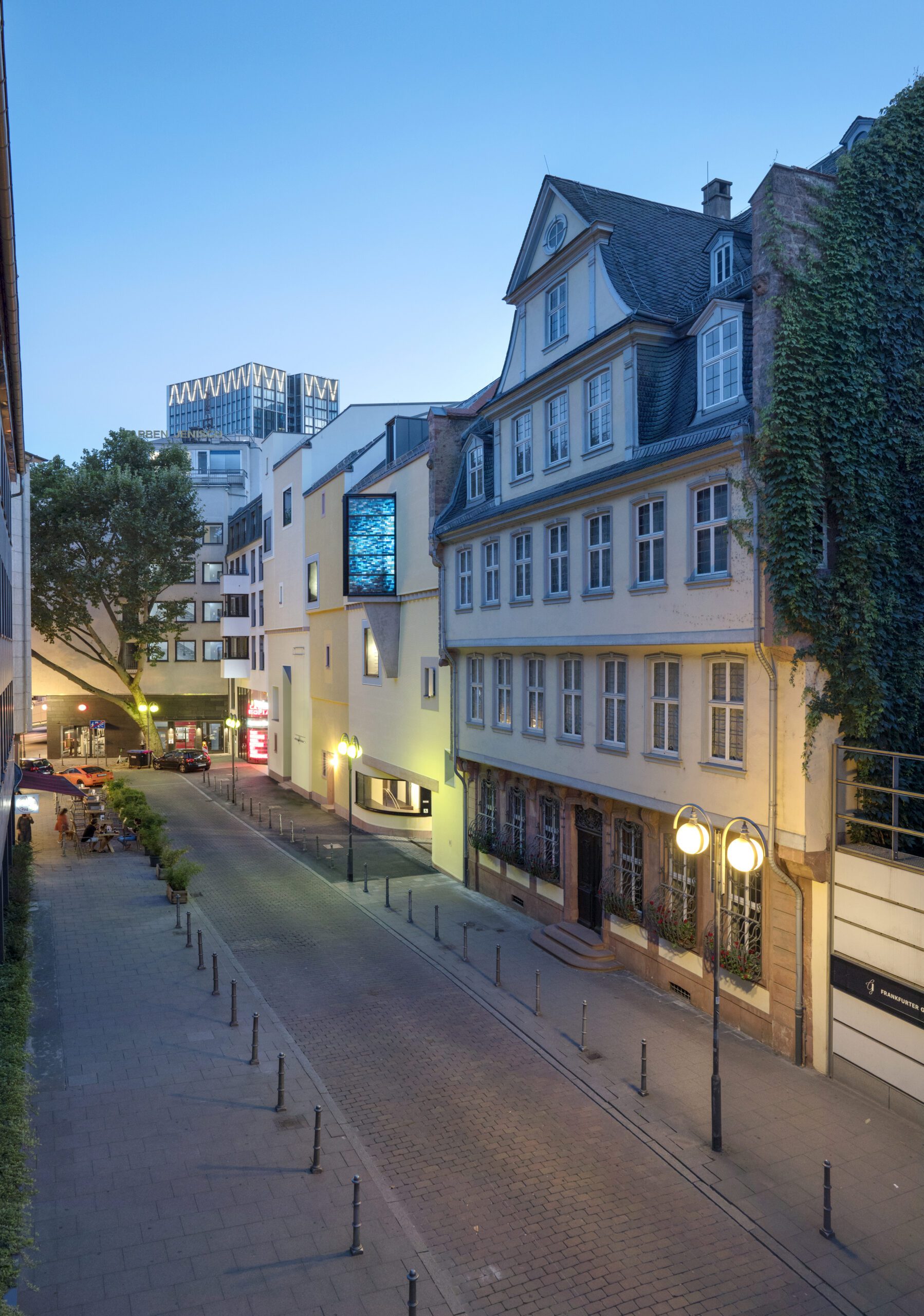
Johann Wolfgang Goethe was born in 1749 in the house on Großer Hirschgraben. He spent his childhood and most of his youth here until he accepted an invitation to the Weimar court in 1775. It was in his childhood home that Goethe created his impressive early works, including ‘Götz von Berlichingen’, the original version of ‘Faust’ and ‘The Sorrows of Young Werther’, which made him famous overnight.
The family life of the Goethes and 18th century Frankfurt come to life in the unique atmosphere of the originally furnished rooms. The rooms commemorate the young Johann Wolfgang, his sister Cornelia, his mother Catharina Elisabeth and his father, the Imperial Councillor Johann Caspar Goethe. It was he who gave the house its present appearance. In 1755/56, he had the two inherited, connected half-timbered houses completely remodelled and a building in the bourgeois rococo style erected. It was destroyed down to its foundations during the Second World War, but was reopened in 1951 after being faithfully reconstructed.
The Goethe Gallery, located in the neighbouring German Romantic Museum, illustrates the poet’s relationship with the art and artists of his time. It connects the Goethe House with the permanent exhibition on Romanticism and spans from 18th century works from Goethe’s circle in Frankfurt, as he got to know them in his parental home, to the 19th century. On display are paintings by Johann Heinrich Füssli, Anton Graff, Johann Philipp Hackert and Angelika Kauffmann, among others. Works by Caspar David Friedrich, Carl Gustav Carus, Carl Blechen and Johann Christian Clausen Dahl, Romantic painters with whom Goethe was also intensively involved, can be seen in the painting cabinet of the Romanticism exhibition.
GERMAN ROMANTICISM MUSEUM
Opening in autumn 2021, the German Romanticism Museum is the first museum in the world dedicated to the era of German-speaking Romanticism as a whole. Valuable original works are presented in innovative exhibition formats that allow visitors to experience the Romantic period as a key epoch. In dialogue with the neighbouring Goethe House, manuscripts, prints, paintings and everyday objects are on display. A multimedia realisation of ideas, works and personal constellations can be experienced. Goethe himself is presented in a new light.
Exhibits include manuscripts by Clemens and Bettine Brentano, Novalis and the Schlegel brothers, Joseph von Eichendorff’s handwritten draft of his famous poem ‘Wünschelrute’ (Divining Rod), the manuscript of Ludwig Tieck’s novella ‘Des Lebens Überfluss’ (Abundance of Life) and Robert Schumann’s handwritten composition drafts for his ‘Szenen aus Goethes Faust’ (Scenes from Goethe’s Faust). There are also well-known paintings such as Caspar David Friedrich’s ‘The Evening Star’, pictures by Carl Gustav Carus, prints by Philipp Otto Runge and much more.
The museum invites visitors on a varied search for the dazzling phenomenon of Romanticism. The 35 stations are arranged according to the historical chronology, but there is no compulsory order for the visit. At the centre of each station, an original from the collection of the Free German Monastery becomes the starting point for a story. The stories told at the various stations touch on, overlap and complement each other. They show what Romanticism can be: an epoch of cultural history, an aesthetic programme, an attitude or simply a feeling.